Using a Collaborative Doc to Learn with Literary Theory
Filed in Teaching with Technology Portfolio
The classic literary theory course is run on a roughly chronological, school-based format: first formalism, then Marxism, then postmodernism, and so on. I designed my section of ENGL 200 differently, instead choosing to put more focus on the concepts that travel across schools of theory. Moreover, I designed the course not to emphasize mastery of the material, but rather the process of theorizing. I wasn’t testing students; I was encouraging them to think with the theorists we read, and to inhabit the sensibility of the theorist: question everything, take nothing for granted. To practice this sensibility, I set up a shared document that my students used to keep track of the concepts and texts we covered. Students updated the document with quotations from the readings that corresponded in some way to the concepts listed on the document.
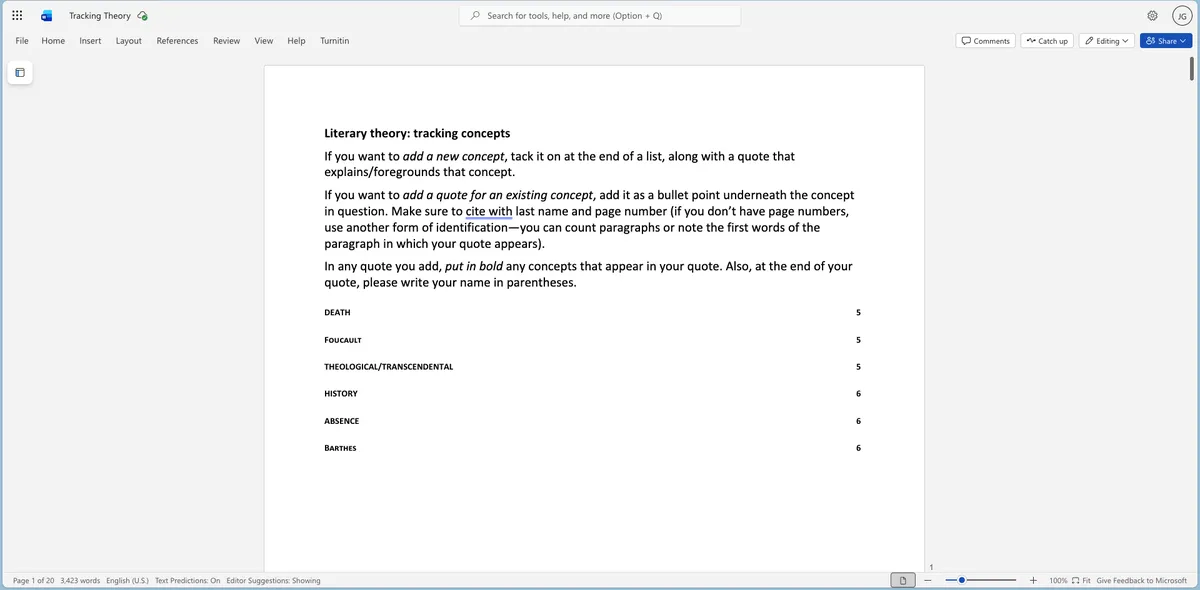
The benefit of this shared concept collection was twofold; it supplemented students’ own reading practices, since it enabled them to track what concepts were appearing across various texts, and it also gave them material for brainstorming how to connect writers for their reflective writing assignments.
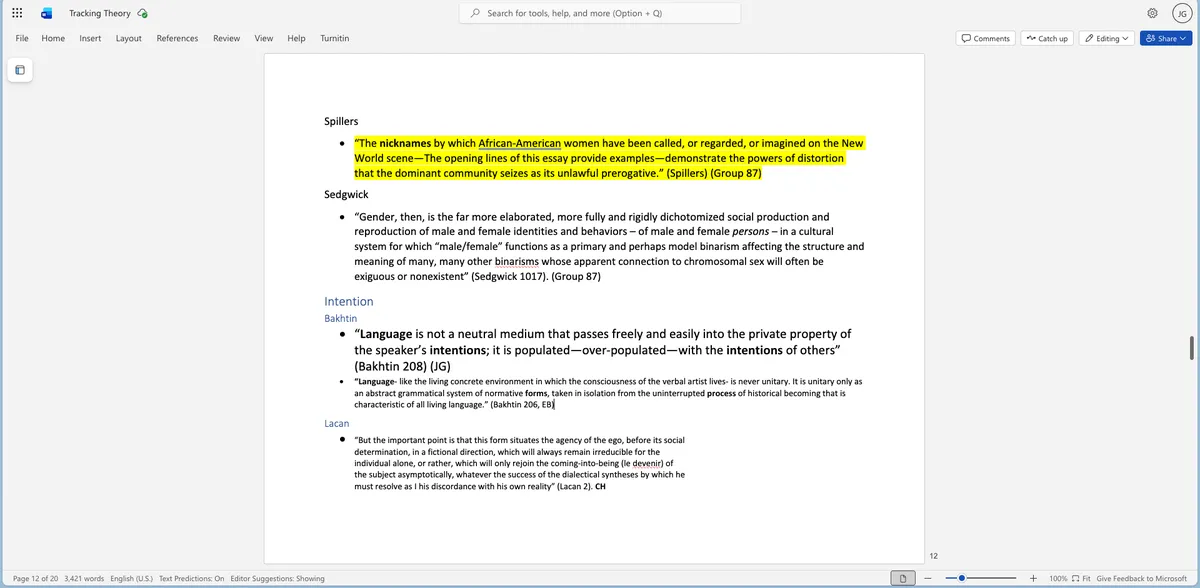
While I do think the shared concept collection was an effective course supplement, it did end up being quite an unruly document. I used Word’s style feature to generate a table of contents, but the online version of Word bookmarks headings less reliably than the desktop version, in my experience. If I were to do this exercise again, I would probably design a lesson about using Word’s features in advance—I was essentially teaching my students how to collaborate on a shared document using Word, but I didn’t make that an explicit part of my teaching at the time. I made the mistake, that is, of assuming the technology was a neutral background operation, instead of an active, foreground aspect of our learning.